
Dandelion Wine
Description
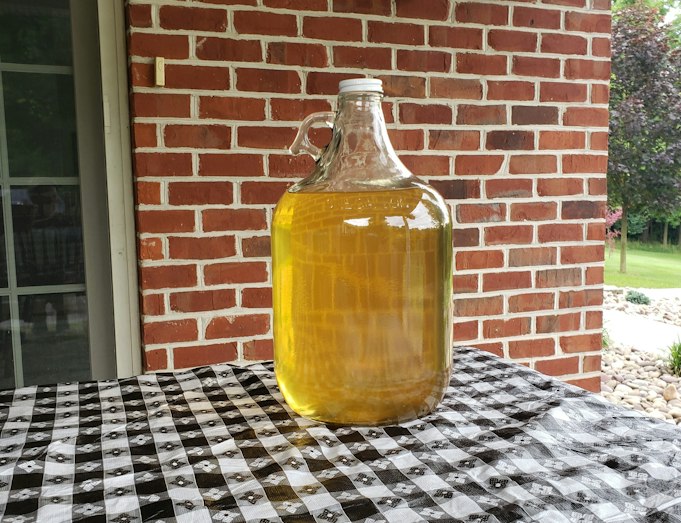
A flower that many people consider to be a nuisance weed can be turned into something really special. Of the wines I have made to date, this one is the most interesting by far. Even at an early age of 30-some days, it had complex taste characteristics, despite the dominant orange-y smell. It's a beautiful gold color, and by my estimation will be at the top of the ABV range for the wines I make: 14%-15%.
The internet is full of different recipes for Dandelion Wine, although the basics are roughly the same. Nearly all of them include citrus fruits and raisins, and it seems that everyone agrees the green parts of the flower should be removed entirely to avoid a bitter brew.
This recipe makes approximately 1 gallon of wine.
Ingredients
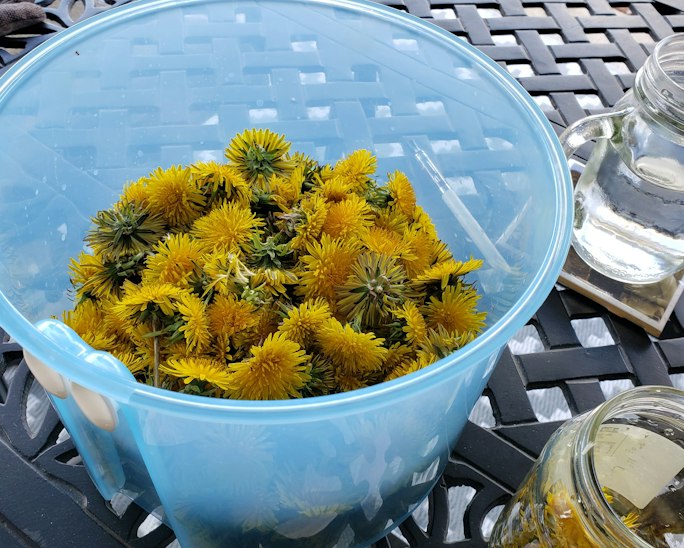
2 quarts dandelion flowers, green parts removed, petals only
1 teaspoon yeast nutrient
1⁄2 teaspoon peptic enzyme
1⁄2 teaspoon acid blend
1 lemon, Juice and zest then chopped into pieces
2 oranges, Juice and zest then chopped into pieces
3⁄4 lb raisins
1⁄2 cup chopped, dried apricots
4 cups sugar
1⁄4 packet Red Star Premiere Classique Yeast


Instructions
Clean and sanitize all equipment.
Bring 1/2 gallon of water to a boil, then pour over the dandelion flowers (I used a crock pot) and let steep for 1-3 days. Some recipes allow for up to 7 days of steeping time, but I'm too impatient for this.
Transfer liquid and flowers to a stove-safe pot, bring to a low boil, add sugar, lemons, oranges, raisins, and apricots. Cool enough that you won't scald yourself while handling and pour through a straining bag into the primary fermenter. Place the straining bag with solid ingredients into the fermenter. Add enough water to bring to 1 gallon mark.
Add all other ingredients except yeast.
Dissolve yeast in 3/4 cup of warm water at around 90 degrees F. When must and yeast are both at around 85 degrees, add yeast to must and stir a bit.
Allow primary fermentation of 6-9 days before racking and removing solid ingredients. Rack to secondary fermenting container.
Rack as needed over the next 3-6 months.
Back-sweeten, if desired, and bottle.


Notes
Some recipes do not call for the flowers to be included in the primary fermentation, but rather the steeping liquid only. As this was my first batch of dandelion wine, I left it all together for primary fermentation. The flowers did make quite a mess of my straining bag, and escaped into the wine, creating the need for multiple filter/rack sessions in the first 30 days to fully remove all of them.
The finished result, just prior to bottling, was a beautiful golden-colored wine with tons of flavor.
End Results
In 2019, this wine recipe was bottled in June. After about 10 months in the bottle, we tried it, and it wasn't bad, but it wasn't great either. As it aged, it became a little better, and reminded me of a white wine you might be willing to pay $8 a bottle. So, I wasn't thrilled with it.
In 2020, I tried again, adding more flowers to the batch and letting the dandelion "tea" steep for a longer period of time. I did 3 gallons, in 1 gallon batches, and the first one had to be thrown out when it became obvious that a wild yeast had taken over while the petals were steeping. For the remaining two batches, I added a campden tablet after the boiled water had cooled.
I'm told that the golden rule with dandelion wine is to let it age for 2 years, and I can attest that after 2 years of aging, this is definitely a favorite. I prefer it dry rather than sweet.